How to Choose the Right Lipo Battery for Your Drone?
Choosing the right Lipo battery for your drone is essential for optimal performance. Renowned drone expert Dr. Emily Chen emphasizes, "The battery can make or break your flying experience." Selecting the appropriate Lipo battery impacts flight time, control, and overall enjoyment.
Lipo batteries come with various specifications. You need to consider factors like voltage, capacity, and discharge rates. Many hobbyists overlook the importance of matching the battery to their drone's requirements. This can lead to underperformance or even damage. A battery that is too powerful can destabilize a drone, while one that lacks power can severely limit flight duration.
As you navigate through different brands and specifications, remember to be reflective. Not every battery will fit your needs perfectly. Each flight provides new lessons. Testing different Lipo batteries will help you find the best match. This journey may involve some trials and errors, but it is part of becoming a skilled drone enthusiast.
Understanding Drone Power Requirements
Choosing the right lipo battery for your drone is crucial for optimal performance. Understanding your drone's power requirements is the first step. Different drones have varying power needs based on size and design. Larger drones often require more power, thus need bigger batteries.
Battery capacity is measured in milliamp hours (mAh). A higher mAh rating generally means longer flight times. However, using a battery that isn't right for your drone can lead to underperformance. Consider the weight of the battery, too. Overly heavy batteries can affect flight stability.
Tips: Always check the voltage of the battery. It needs to match your drone's specifications. A mismatch could result in damage. Don’t rush into buying the first battery you see. Compare options. Look for user reviews for insights. Reflect on your drone's usage patterns; do you need long flights or acrobatic maneuvers?
How to Choose the Right Lipo Battery for Your Drone? - Understanding Drone Power Requirements
| Battery Type |
Voltage (V) |
Capacity (mAh) |
Discharge Rate (C) |
Weight (g) |
Flight Time (min) |
| 3S LiPo |
11.1 |
2200 |
20 |
200 |
8 |
| 4S LiPo |
14.8 |
3000 |
30 |
300 |
10 |
| 5S LiPo |
18.5 |
5000 |
20 |
400 |
12 |
| 6S LiPo |
22.2 |
4000 |
25 |
450 |
14 |
Types of LiPo Batteries Suitable for Drones
When selecting a LiPo battery for your drone, understanding the different types is crucial. The most common are 2S and 3S batteries. A 2S battery has two cells, while a 3S has three. More cells usually mean more power. However, they also come with added weight, which can affect flight time.
High-capacity batteries, like those rated at 5000mAh, can provide longer flights. But they are larger and heavier, potentially making your drone less agile. Choosing a battery involves a balance. If you prioritize speed, a lighter battery may suit you better. Conversely, if you want longer flight durations, heavier options might be necessary.
Don’t overlook connector types. Compatibility with your drone is essential. Some connectors are easier to work with than others. A poor connection can lead to unexpected crashes. Always double-check your choices before flight. It’s easy to make mistakes that could cost you dearly.
Battery Capacity Comparison for Drones
Key Specifications to Consider When Choosing a LiPo Battery
Choosing the right LiPo (Lithium Polymer) battery is crucial for your drone's performance. One key specification to consider is the battery's capacity, measured in milliampere-hours (mAh). A higher capacity can offer longer flight times, but it also adds weight. It's a balancing act. Another essential aspect is the voltage, typically indicated by the number of cells, known as "S" for series. More cells mean higher voltage and more power, but it also increases complexity.
C-rate is another vital parameter. It denotes how quickly the battery can be charged or discharged. A higher C-rate allows for faster acceleration and responsiveness. However, the drawbacks include potential overheating. Always check the discharge rating. Then there's the physical size and weight, which can be restrictive. A battery too heavy or large for your drone may affect flight stability.
The environment can impact battery performance as well. Cold temperatures can reduce capacity. Hence, testing in different conditions is important. Reflection on your specific needs and flying style can also lead to better choices. Remember, not every battery works for every drone. Take your time when making decisions on specifications.
Balancing Capacity, Voltage, and Weight for Optimal Performance
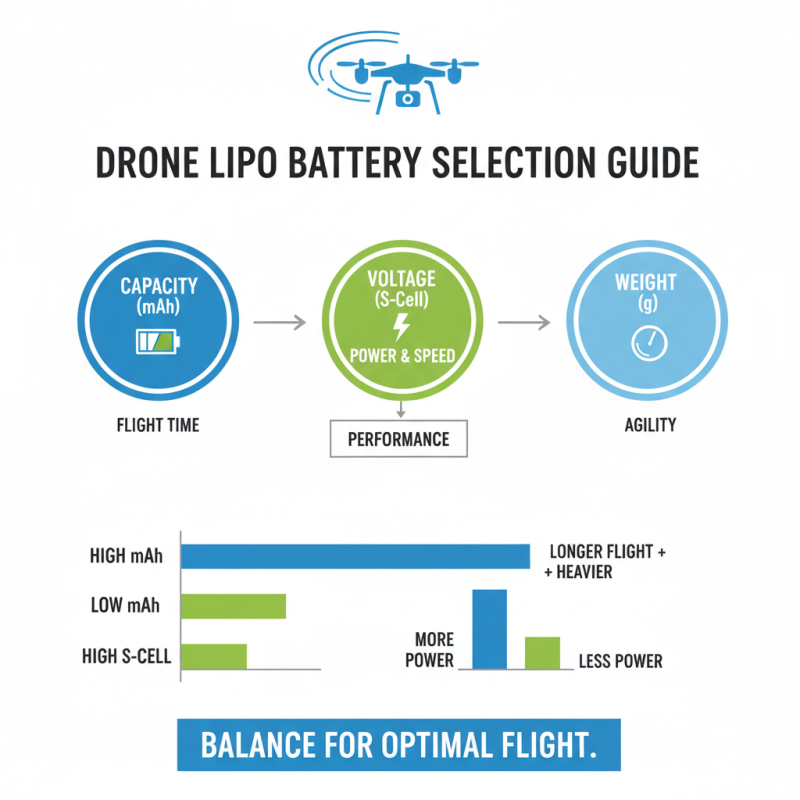
Choosing the right LiPo battery for your drone is crucial for optimal performance. Balancing capacity, voltage, and weight helps maximize your flight experience. Capacity, measured in milliamp-hours (mAh), dictates how long your drone can fly. Higher capacity equals longer flight time, but adds more weight. This can negatively impact agility and speed.
Voltage plays a significant role as well. It determines the power output of your drone. Ensure your chosen battery matches your drone's requirements. Mismatched voltage can lead to inefficiency, which is not ideal. You may find yourself needing to land sooner than expected if the voltage is too low.
Weight should always be a consideration. A lighter battery enhances maneuverability. However, it might compromise capacity. Striking the right balance is an ongoing challenge. Everyone aims for the perfect combination, yet the best choice often depends on unique flying styles and drone types. Don’t hesitate to test different configurations. Reflect on your flight patterns to find what works best. Each flight is a learning opportunity.

 +86-13928815851
 CONTACT NUMBER
 CONTACT NUMBER